Moesgaard Museum Carries Out Excavation in Agro Food Park
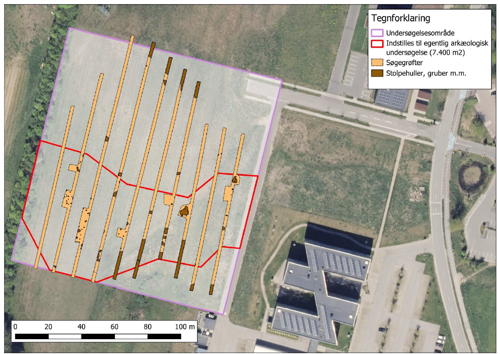
In the summer of 2025, Moesgaard Museum conducted an archaeological preliminary investigation on selected undeveloped construction plots in Agro Food Park. The purpose of the investigation was to determine whether any archaeological remains are present in the area before new buildings are planned and initiated. The preliminary investigation revealed traces of two house constructions and pottery from the Pre-Roman Iron Age (500 BC – AD 0), as well as flint from the Neolithic period (Funnel Beaker Culture, 4000–1700 BC).
In weeks 6–8, Moesgaard Museum will therefore return to Agro Food Park to carry out a full excavation of the area with the aim of determining the size, character, and final dating of the house constructions by collecting soil samples and artefacts for further analysis. It is expected that Moesgaard Museum will release the areas following the upcoming weeks of investigation.
The excavations in Agro Food Park follow a series of remarkable discoveries in northern Aarhus. For example, at Lisbjerg, Moesgaard Museum has uncovered 30 Viking graves with rich grave goods, including coins, weapons, a casket with gold thread, and evidence of a magnate’s residence pointing to connections with royal power. At Nye, remains from the Late Ice Age have been found, including reindeer and aurochs antlers, demonstrating human activity more than 10,000 years ago. The discoveries span from Stone Age hunter-gatherer societies to the elite of the Viking Age and enrich our understanding of Aarhus’ early history.
Current findings confirm that the Aarhus Bay area was one of the most highly developed and densely populated regions in Denmark prior to the Viking Age. Evidence of early agricultural development has also been uncovered. One of the earliest dated grain finds in the country, from around 3950–3800 BC, comes from a settlement near the former Egå Fjord coastline. Humans made use of the area’s resources long before the founding of the city of Aarhus in the Viking Age, and locally based trade gave the region an outward-looking character very early on.
Janne Pløen, project manager in Agro Food Park, explains that Agro Food Park is working to set up an event together with Moesgaard Museum, where they will present the findings from the excavation and discuss whether and how the settlement in Agro Food Park may have been connected to other discoveries in the Skejby area from the Pre-Roman Iron Age.